Wednesday, February 28, 2007

Trip Update Feb. 2007


We started this month at Myakka State Park, near Sarasota, which is as far south as we got this trip. We took a wildlife cruise on the lake at the park, but the weather was too cold and windy for much activity. We headed up to the Hillsboro SP, near Tampa, and canoed the Hillsboro River down to the Dead River. We proceeded to Silver Lake SP because other campers were telling us how nice it was. From here we canoed Juniper Springs, in Ocala National Forest, our all time favorite creek. It is very small, but beautiful, full of twists with wildlife beyond each turn. Since Silver Springs was right next to the campground, we decided to check it out. See the separate attachment, “Monkey Business” for a report on this visit.

At Manatee Springs, we went out with a manatee expert and several manatees swam up to our canoe. In west central FL we found some real wilderness in the Lower Suwannee National Wildlife Refuge, good for canoeing, dirt biking and dry camping. We explored Cedar Key and learned about its history of pine, cypress and cedar logging (for pencils) and collecting oysters, fish, sponges and sea turtles until the supplies ran out due to exploitation.

We joined a Winnebago RV club for Rialta owners. It turned out they were having a get together of Rialta owners in north Florida. Forty-six Rialtas in one campground was quite a sight. We compared modifications, exchanged ideas, and even got some modifications completed.

We entered the Okefenokee Swamp from the west side and camped at Stephen Foster SP. The canoeing was excellent, large gators were everywhere. The west side is much more scenic than the east side where we canoed previously. Tall cypress trees covered with Spanish Moss lined the waterways. We practically had the swamp all to ourselves.

Did you know?
Raccoons wash their food because they can not produce saliva.
Owls have to swivel their heads because their eyes are fixed in their socket.
Stephen Foster never saw the Suwannee River.
Rednecks go to Napa Valley to see how they make auto parts.


Monkey Business

Last month I told you about the alligators and manatees in Florida; now would you believe me if I told you there were wild monkeys there also. Actually most people in Florida and even some people who should know such things (like naturalists and park rangers) are unaware of this fact

Although I’ve been to Central Florida at least a dozen times, I had never visited Silver Springs. Maybe you have never been there either, but I am sure you have seen it. All of the “Sea Hunt” TV shows were filmed there, the first six Tarzan movies, and several scenes from James Bond movies were also filmed there. Also the “Creature from the Black Lagoon” and other jungle/ underwater movies were shot at the Springs. So one day we went there and toured the grounds. We also took three different glass bottom boat rides along different sections of the Sliver River. We floated over the large sink where Silver Spring emerges from the ground.

We learned a lot about the history of the place. It has been a commercial resort 23 years before Walt Disney was born. In the 1930’s Colonel Tooey, a concessionaire who operated the Jungle Cruise boat ride, deposited a boat load of Rhesus Monkeys on a island at the resort. The next day he brought a boat load of tourist to the resort to see his latest attraction. As luck would have it, there was one thing he did not know about these moneys - they were excellent swimmers! When the tourists arrived at the island, the island was deserted. Over the 80+ years since then, the monkeys have appeared over much of east central Florida, but are still mostly in the area where they got off the boat (just like a lot of New Yorkers). We did not see any monkeys that day, although one of our guides said he has seen them on a previous trip that day. Now I really wanted to see them. The next alternative was to canoe up the Silver River and hope that we see them.

We had never canoed the Silver River before because we thought access to the springs was blocked by the resort. We learned this was not the case, so we set out on our quest for the elusive wild monkeys of Sliver Springs. The Silver River, of course, starts at Silver Spring. This is a first magnitude spring, discharging 500 million gallons a day of 71 degree water year-round. This is one of the largest springs in a state full of springs. It took 3 hours of steady paddling to travel the five miles to the springs. On the way up we saw 22 gators, lots of beautiful tropical birds and hundreds of turtles; but not a single monkey! We floated over the spring and saw underwater props from an old James Bond movie. We started our easy paddle back down river. After about two miles we saw a few canoes near shore. They had found a group of about 16 monkeys. A mile downstream, we found another group of 8 monkeys. It made our day! Now the Silver River is our favorite canoe run – in a state of wonderful canoeing spots.

Wednesday, January 31, 2007

Trip Update Jan 2007


Our time in Destin was spent hiking, touring, birding and biking. After a few rainy days in a timeshare, we were back to camping. Blackwater State Park provided a good location for canoeing some small streams. The stream levels were several feet above normal, which kept the outfitters from putting anyone on the river. This made it perfect for us. First we did Juniper Creek. We carried our bikes and canoe on a trailer behind the RV. On the shuttle my bike fell from the bike rack. It was dragged for several miles, before some roadside hunters flagged us down. The rear wheel of the bike was still attached to the rack, but the rest of the bike was left hanging. The worse damage was to the rear wheel which got twisted out of shape. As a result, Pat ran the bike shuttle by herself. The next day we ran Coldwater Creek. It was also running high and fast. There were several blockages on the river which would have made it very dangerous for novice paddlers.

We left the Blackwater area and headed toward Pensacola. On the way we stopped at Bayou Marcus Reclamation Facility to do bird watching from their 1.5 mile boardwalk over their wetlands area. Of course I could not resist meeting the operating personal of the wastewater treatment plant and getting the inside scope on their operation. Even before wetland treatment they were discharging an excellent effluent. We camped a few nights at Big Lagoon State Park. This was one area of Florida we had not explored before.

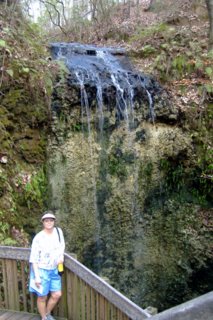
Time to go canoeing again, so we moved camp to Falling Water State Park. Believe it or not, they have a waterfall with a drop greater than 150 feet! We canoed Holmes Creek, but unlike the previous creeks there was little current. The river was swampy and took much longer to complete than anticipated. At one point a gator swam right up to the canoe and started to circle it. He disappeared as we reached for the camera. We also toured the Florida State Caverns then left the Panhandle and headed south.

In the Tampa area we canoed the Hillsborough River and took pictures of the amazing amount of wildlife along that stretch of river. We also went to an RV Super Show at the Tampa Fairgrounds. In Orlando we had a timeshare for a few nights. We went to Universal Studios and Island of Adventure Parks in one day. Cirque du Soleil completed our spending spree (worth every penny!).

We visited Blue Springs on a cold day and saw dozens of manatees. We canoed the Lower Wekiva River and Peace Rivers which were very scenic. We took a Swamp Buggy ride to see some wildlife. The later part of the month has been very cold (for Florida) so we have not seen many gators while canoeing. Hopefully February will be warmer.

Friday, January 12, 2007

Adventure or Fantasy

Time Travel

It was April 1692, and Pat and I were walking through the Town Square in the Village of Salem. A man stood on a bench and announced the news of the day. He was interrupted by an officer of the court who explained that there was a warrant out for Bridget Jones because she has been accused of performing witchcraft. He described what she was wearing and soon she was spotted in the crowd. She was taken into custody. Declaring her innocence, she resisted this attempt to apprehend her. I was asked to grab her arm and help control her. I held her tight and escorted her to the courthouse.

Pat and I were asked to be part of the jury for a hearing to see if she should be held for a witchcraft trial. Several of her neighbors came in and provided details on her unusual behavior and her sudden appearances in their house. As jurors, we were able to ask the defendant and the witnesses questions. When the hearing was over, the jury was polled and the jury found that Bridget Jones should be held for trial.

Later we found out that the trial was held and Bridget Jones was found guilty of witchcraft. She became the first person in the US hanged for witchcraft. We both feel safer now that that this witch is off the streets. We hope this counts as our jury duty-it was a wicked good time!

.......................................................

Monkey Business

Last month I told you about the alligators and manatees in Florida; now would you believe me if I told you there were wild monkeys there also. Actually most people in Florida and even some people who should know such things (like naturalists and park rangers) are unaware of this fact

Although I’ve been to Central Florida at least a dozen times, I had never visited Silver Springs. Maybe you have never been there either, but I am sure you have seen it. All of the “Sea Hunt” TV shows were filmed there, the first six Tarzan movies, and several scenes from James Bond movies were also filmed there. Also the “Creature from the Black Lagoon” and other jungle/ underwater movies were shot at the Springs. So one day we went there and toured the grounds. We also took three different glass bottom boat rides along different sections of the Sliver River. We floated over the large sink where Silver Spring emerges from the ground.

We learned a lot about the history of the place. It has been a commercial resort 23 years before Walt Disney was born. In the 1930’s Colonel Tooey, a concessionaire who operated the Jungle Cruise boat ride, deposited a boat load of Rhesus Monkeys on a island at the resort. The next day he brought a boat load of tourist to the resort to see his latest attraction. As luck would have it, there was one thing he did not know about these moneys - they were excellent swimmers! When the tourists arrived at the island, the island was deserted. Over the 80+ years since then, the monkeys have appeared over much of east central Florida, but are still mostly in the area where they got off the boat (just like a lot of New Yorkers). We did not see any monkeys that day, although one of our guides said he has seen them on a previous trip that day. Now I really wanted to see them. The next alternative was to canoe up the Silver River and hope that we see them.

We had never canoed the Silver River before because we thought access to the springs was blocked by the resort. We learned this was not the case, so we set out on our quest for the elusive wild monkeys of Sliver Springs. The Silver River, of course, starts at Silver Spring. This is a first magnitude spring, discharging 500 million gallons a day of 71 degree water year-round. This is one of the largest springs in a state full of springs. It took 3 hours of steady paddling to travel the five miles to the springs. On the way up we saw 22 gators, lots of beautiful tropical birds and hundreds of turtles; but not a single monkey! We floated over the spring and saw underwater props from an old James Bond movie. We started our easy paddle back down river. After about two miles we saw a few canoes near shore. They had found a group of about 16 monkeys. A mile downstream, we found another group of 8 monkeys. It made our day! Now the Silver River is our favorite canoe run – in a state of wonderful canoeing spots.

.......................................................

Trouble in Paradise

We returned home from our Alaska/Canada trip on Nov. 4 in time to celebrate our 24th wedding anniversary. After a week of getting together with friends and family we flew to the island of Bonaire in the southern Caribbean, east of Aruba. Bonaire is a world renowned diving destination with coral reefs surrounding the island. Eldon and Lois invited us to stay with them in their cottage at Captain Don’s Habitat. This was our third visit to the island. My first order of business was to check on the start up progress of a Biological Nutrient Removal Plant designed by former co-worker Yanjin Liu. I tested some wastewater samples and made a list of process/piping changes. After that, the week was relaxing - we did some snorkeling and enjoyed meals at some old favorite restaurants and found a new one.

Eldon took us on an island tour with a visit to an abandoned lighthouse. After a harrowing climb up a questionable staircase, we had a great view of the island and coast. One activity that we wanted to do there was land sailing. Basically you drive a wind powered cart around a track. We tried to set this up but the wind did not cooperate, so I guess it will have to wait until the next visit.

Still seeking something different to do, I suggested we try night snorkeling. Night diving was popular, so why not try night snorkeling? I rented waterproof flashlights from the dive shop and we were ready to go. Pat, Eldon and I got in the water from the resort’s dock about 9:30 PM on Friday. I was not sure how I would like this, but once in the water, I relaxed and enjoyed seeing sea snakes, several 5 foot long tarpon and lots of tropical fish. After about 20 minutes in the water, I felt a burning sensation on my neck. I turned to see what was there and I saw a jellyfish swimming away. Having been stung by sea nettles in the Chesapeake Bay, I knew that the initial pain would soon go away. I decided not to raise an alarm, but to continue snorkeling. Instead of dissipating, the pain increased. I called Pat over to see if I had tentacles stuck to my neck. She could not see anything there. Eldon asked what the problem was and decided we should all go back to the dock. Fortunately the dock was not far away because I was having trouble swimming due to the pain which had traveled down my left leg. I got my flippers off and staggered up to the bar area and sat down. Pat went to get meat tenderizer from the restaurant. The pain was intense and I was cold and wet. I had uncontrollable shaking and sweating.

The resort manager, Jack Chalk, recognized the symptoms right away and called for an ambulance. He said I had been stung twice by a sea wasp, a.k.a. a box jellyfish. Pat returned with vinegar which was applied to my neck. I was wrapped in towels to keep warm. I remember Jack yelling the words "Where's my damn ambulance" into his phone mike when it seemed the EMS should have been there already. Once they got there, Lois, who is a nurse, was on top of the situation the whole time, making sure that things got done right.

The EMS team finally came and took my vitals. My BP was very low, so they gave me an IV with an antihistamine and a steroid. I was loaded into the ambulance and taken to the nearby ER.

The doctors observed me for a while and then gave me a second dose of medication. The doctors at the ER were familiar with this type of injury. They treat 5-10 similar cases a month. They said the venom from the sea wasp has 15 pathways into the body, and a sting by a Portuguese Man of War was like a bee sting in comparison. After an hour or two I started to feel less severe pain. My neck continued to be very sensitive - any type of contact to the injured area would send acute pain through my body. After two hours in the ER, I was released.

That night, I lay in bed profusely sweating for hours. By morning the sweating had stopped, but my neck continued to be very sensitive to any contact. It would be about 48 hours before I could touch my neck without pain or get a good night’s sleep. Although no one has died from Sea Wasp stings in the Caribbean, over 70 have died off the coast of Australia. I guess their box jellyfish are bigger and more toxic. I’ll let you know. We are heading to Australia and the Great Barrier Reef this spring! I will not be going night snorkeling (unless I feel the need for a great (or not so great!) follow-up story).

.......................................................


I bear-ly survived


It was early in the morning, and I was wide awake, so I got up and got dressed without waking Pat up. I decided to go out and look for wildlife, since it was supposed to be a good place and time to do that. I grabbed my binoculars and camera and headed down to the lake hopping to see moose. The sun was not up yet, but the sky overhead was blue and the horizon was three shades of pink. There was much activity at the lake. A beaver was swimming by with a piece of debarked tree limb, heading for his dam. A loon was diving for breakfast while its little one waited on the surface. The first time you hear the call of a loon, you wouldn’t think it was coming from a bird, unless that bird was being strangled. It’s a sound you don’t soon forget. The call lets you know you are in the North Country and welcomes you to the wilderness. The baby loon had not yet developed the distinctive black and white marking of an adult loon; it was mostly gray with a white underbelly. Pass the loons; a pair of Trumpeter Swans was gliding along in the distance. Their whiteness contrasted nicely with the surrounding earth tones. I lifted my binoculars and scanned the shoreline for moose. This was the right time and place to find them. They like to brose on the marsh vegetation near the edge of the lake. I waited patiently for the Moose to appear, but without success. Finally I decided I would take a trail through the woods up to a better vantage point.

The trail was overgrown and it made for difficult hiking. Many parts were muddy, but that was the best part, because you could see the tracks of many animals that had passed by here recently. The most obvious were the moose, wolf and elk prints. There were many others that I would have to refer to my tracking guide to distinguish. I did see a print that got me excited, a large bear paw. I didn’t need a guide book to interpret this 14 inch print. I was hoping that a print would be all that I would see of this bear. This made me a little nervous, because I knew I shouldn’t be hiking alone in bear country.

They say solo hikers should sing or wear silver bear bells on their shoes. There are two theories about using bear bells. The first is that the bear will hear you coming and leave the area before you even knew it was there. The second theory is that it’s the bear’s dinner bell. I guess I subscribe to the second theory. I figured if I didn’t find any more evidence of a bear I would be OK. Unfortunately, further up the trail I found a fresh pile of you know what. Now at this point I was wondering if this was left by a black bear or a grizzly. According to the locals, the way you can tell the difference is to check the scat pile. If it contains parts of little sliver bells, it is a grizzly. I put on my CSI hat was ready to investigate further, when I hear it approach. There, not more that a few feet away was the deadliest creature known to man (excluding man, of course). I knew what my options were, but making the right decision could make all the difference. My first instinct was to get out of there, but I knew I could not out run it on this trail. Climbing a tree was not an option since they were all evergreen. I could roll over and play dead, but that idea didn’t appeal to me. I decided to fight.
I did have a size advantage; I was up against a female. Females are smaller but much more aggressive. I took the first swing at her, but she dodged my swing. She was surprisingly quick. My left also missed the mark and she darted behind me. I quickly turned around to face her, but then I hear a noise that told me that her reinforcements were coming. As I glanced over my shoulder to see what was coming behind me, she saw her opportunity and came in for a bite at my jugular. My reflexes kicked in and my right hand moved at lighting speed and swashed that damn mosquito before it could get away. I flicked it to the ground. Now I was ready for the rest of her family!
I hope you didn’t think I was taking about Grizzly Bears. Very few people die from Grizzly encounters. Some mosquitoes however carry malaria and can transmit 9 other diseases. Millions have died as a result of mosquito bites.

Before I go in the woods now, I carry protection against such killers. See attached photo.

Tuesday, December 12, 2006

Trip Update #12

Mid-October found us in snowy Colorado. We stayed in a time share in Granby for a week and took a break from being on the road. If October was an indicator, we are not surprised Denver is buried in snow in January. We found Winter Park to be a nice ski town with good restaurants. We felt lucky to get out of there before we were snowed in because their first big storm came in just after we left.

In Nebraska we camped at E.T. Mahoney State Park, one of the nicest parks we have ever stayed at. After our first night there, we toured Omaha attractions; the zoo, the Old Market and the Heartland of America Fountain. When we returned to our camp site, we found that the few items that we had left there had been stolen. It’s like we never left Prince George’s County! After a trip to Wal-Mart and $70, we replaced the stolen items..

In Ohio we visited with our friends Janet and Lowell and had our first home cooked meal in four months. At our next stop, we checked out the views from Grandview Ave overlooking downtown Pittsburg. We stayed 4 nights at Wolf Run Manor in DuBoise, PA. Pat’s parents joined us for a couple of days. We took a scenic drive and saw a group of 11 bull elks along the road. They all had extensive racks - it was more impressive than the elk we saw in Yellowstone! Of course no one had brought a camera. We returned to York and celebrated our 24th Anniversary at the Accomack Inn with Pat’s parents (also a belated Mother’s Day celebration!)

After a visit with my family and celebration of my father’s 84th birthday, we flew down to Bonaire for a week. For details be sure to read “Trouble in Paradise”. We returned in time for Thanksgiving dinner with Pat’s family. We spend three nights at the Massanutten Resort. After a long timeshare presentation (we didn’t buy), we drove to Shenandoah National Park, only to find Skyline Drive closed due to an ice storm. We parked and hiked the Appalachian Trail. It was rough going, climbing over downed tree branches. According to the ranger, several inches of ice accumulated on the tree branches during a recent storm. The next week we drove to Williamsburg, VA. We took a guided night tour of the historic area and returned during the day to see the Christmas decorations.

In between these trips, we moved between Waldorf, Laurel and York. When not in a hotel, we spent many nights at Tom & Julie’s, Linda and Rick’s, and her parents’ home. It was good to spend time with our friends, families and former co-workers. Russ and Shirley lent us one of their cars when we needed one after we sold our Subaru, which was not being used very much.

Two goals we wanted to accomplish while we were back in the area were to catch up on doctor visits and get work done on the RV. We accomplished the first but the second proved more elusive. After six weeks at the RV dealership, and two more visits to different shops, we still could not get our load air bags replaced and our remote key lock transmitter replaced. We finally gave up and headed south. In Atlanta we went to the new Georgia Aquarium. Their large tanks with the Beluga whales and whale sharks made it worthwhile. We are currently in Florida.

We’re back on the road, and very happy to be here!! It was great to see our friends, family and former co-workers. Unfortunately, we were not able to catch up with everyone, but it is a busy time of year. Since we did not have the RV for 6 weeks, we appreciate our family and friends who ‘put us up’ – and those who offered. Although it was nice to be back in the MD/PA area, we’re enjoying being on the road again.

Thursday, October 12, 2006

Update #11 Montana to Colorado

Glacier National Park

This park is famous for its Going to the Sun highway which bisects the park east to west. We approached from the west so we headed for Logan Pass which crosses the Continental Divide. At the top we saw an animal that we had missed seeing up close and personal in the North Country - a mountain goat. Due to road construction the road was closed at Logan Pass, so after we completed a few hikes, we had to return to the west entrance and drive around the park to the east entrance. There we hiked to several waterfalls and drove the other half of the Going to the Sun highway. At our campground, we were startled by a strange noise nearby. It sounded something like this: it started with an eerie screech like opening a barn door with rusty hinges followed by the cough of a sick horse. It’s quite a disturbing sound the first time you hear it on a moonless night, but don’t know the source. It was the bugling of a bull elk! Good thing they have rangers to explain these things!

Yellowstone National Park

My first visit to Yellowstone was in 1972 during a 4 month cross-country trip. What I remember most about that trip were the bears. Bears were everywhere, at least everywhere people were present. They also congregated at the park dump. My next visit was in 1986 - by then the bear problem was being better managed, and roadside viewing of bears became less likely. Now the parks push “A Fed Bear is a Dead Bear” policy. They try to eliminate all human (and human food) contact with bears. Of course the real problem is ignorant tourists, not the bears. While the rangers may prefer to shoot these tourists, they instead have to use rubber bullets to shoot the bears that show little fear of humans. This is to train them to stay away from where people are present. If this doesn’t work, relocation and termination can also be used. It sounds harsh but has actually been quite effective. The proof is that, despite a healthy bear population, it is rare to see a bear near the road.

There are hundreds of elk and bison near the road that are just waiting for their picture to be taken; however, this time of year you have to keep a safe distance from the bull elk. At Mammoth Springs, one bull, with his harem of cows nearby, would stand outside the main hotel and ram cars when passengers took his picture. The rangers were busy with crowd control and filling out at least a dozen elk-damaged car accident reports daily. Other wildlife that you are not likely to see include the wolf which was introduced about 10 years ago and the mountain lion which reintroduced itself a few years ago (without any help from Congress). This has greatly enhanced the natural wildlife environment.

The other big event in recent Yellowstone history was the fire of 1988. Major portions of the park were burned in that famous forest fire. Recovery is progressing well. Most of the forest in Yellowstone is Lodgepole Pine, and the seeds from these trees need fire to open. So the natural reseeding of Yellowstone started before the fire was extinguished. In most areas the new growth is 3 to 15 feet tall. In some areas the growth is so thick and lush, it looks like a turf farm from a distance. A few areas burned a second time before the new growth could produce seed cones. These areas will take longer to recover. Most of the bushes enjoyed by moose were destroyed by the fire, so the moose moved south into the Tetons.

We spent three days visiting the geysers, fumaroles, mud pots, canyons and waterfalls of the park. We were heading in for a fourth day, but a snow storm and road closures convinced us to bypass the park and head south to Jackson, WY.

Teton National Park

Since we could not head south through Yellowstone NP, we had to cross Teton Pass (elev. 8431 feet). The only problem was it was snowing and there was a 10% grade up and a 10% grade down. We made it OK, but it was hard on the nerves! The next day was very clear and the mountains had a fresh coating of snow. We hiked around Jenny Lake to Hidden Falls, Inspiration Point and into Cascade Canyon. It was a long but beautiful hike. The next day we took a hike with the hope of seeing some wildlife in a remote setting. We found Trumpeter Swans at Swan Lake (how did they know?) and a large herd of elk with several big bulls passed nearby us. From here we headed south toward Flaming Gorge National Recreation Area. On the way we saw so many pronghorn antelope that it seemed the ranchers were raising them. We later found out that there are more of these antelope in Wyoming than there are people.

Flaming Gorge National Recreation Area

John W. Powell named this canyon during his exploration of this area. The outfall from the dam is an International Blue Ribbon trout fishery. Fishing is big business here. We saw herds of elk, big horn sheep, mule deer and pronghorn antelope.

Dinosaur National Monument

We only had time for a quick visit; we’ll have to come back for more. From here we are heading home with a few rest stops thrown in for good measure. We’ll be back in the MD/PA area by Nov. 3.

This concludes the Summer Semester of our Roads Scholars Program. Future courses in the next 12 months will be held in Bonaire, Florida, Australia, British Columbia, Minnesota, Michigan, Ontario and other places yet to be determined.

Be back in touch next year.
Don & Pat

Thursday, September 28, 2006

Trip Update #10 Jasper to Fernie


In our last report, I told you about the snow storm we got caught in. When it was over there was 16 inches on the ground where we camped. As we approached Jasper NP, the snow quickly disappeared at ground level. The mountains were covered with their first of many snowfalls for the season. When we took a dip at the Miette Hot Springs, we found out they had 24 inches of snow, and the snow caused a three day road closure to the springs. We were told that this was quite unusual weather, but it seems every place we go is having unusual weather.

We took advantage of the one clear day we had in Jasper and took the Tramway to the top of Whistler Mountain. The views of the snow covered mountains were outstanding. We hiked various trails for several days and saw numerous elk and big horn sheep. We drove down the Icefields Parkway to Lake Louise and Banff. On a side trip to Yoho NP, we saw the Spiral Tunnels. Trains go into the tunnel in one direction and emerge out of a lower tunnel going in the opposite direction. Because the trains are so long you can see the same train going in opposite directions at the same time. You just have to see it.

While in Banff we enjoyed the Banff Hot Springs. (Do you see a pattern here?) We also visited the Cave and Basin hot springs area. Although no longer open to bathers, it is an important historical site. The discovery of this hot spring led to the Government of Canada establishing its first national park here in 1885. Tropical fish grow wild in the marshy lakes downstream from the spring, and birds winter over instead of flying south.

For a little diversion, we headed for Calgary. The idea was to do the luge and bobsled runs that are open to the public. In a classic case of poor timing, the outdoor bobsled run did not open until Oct 1 and the indoor luge run was closed for maintenance. We did visit the ski jump tower and some of the other facilities on site, but nothing to get your heart pounding. The ski lifts were modified to handle mountain bikes. From the number of dirt bikers we saw, I would say this was a successful conversion. The following day we visited the Calgary Zoo which was OK.

From Calgary we went back to the mountains to an area called Kananaskis County. This is a little know area, south of Banff, used mostly by locals. We went from full campgrounds at Jasper, to having the entire campground to ourselves. We are currently in Fernie, B.C.

Friday, September 15, 2006

Trip Update #9 Whitehorse to Jasper


Before we left Whitehorse we took in the Frantic Follies Show, a vaudeville review that was quite entertaining. One of their skits was based on a Robert Service poem, “The Cremation of Sam McGee”. The Yukon River flows through Miles Canyon in Whitehorse and we hiked around the canyon and found the ghost town of Canyon City. Here the Gold Rush Stampeders unloaded their rafts and carried their belongings overland to avoid the famous Whitehorse Rapids in the canyon. All that remained in Canyon City was hundreds of rusted tin cans. We left Whitehorse and headed to Watson Lake. Watson Lake is famous for its “Sign Forest”. Over 60,000 signs have been left and nailed to posts by travelers. These included road signs and handmade signs. We left the Yukon and entered British Colombia.

There was one striking difference between the Yukon and British Columbia. We were in the Yukon for 3 weeks and saw one black bear. We were in BC for 10 days and saw 3 grizzly bears, three black bears, 60 bison, four caribou, three moose, several deer, a coyote and a cougar - better than a drive thru the zoo! Several friends had told us not to miss Liard Hot Springs. The first night we visited these natural pools, we had the hot springs all to ourselves. We camped at the park that night and we were back in the hot springs in the morning.

The original Alaska Highway was built by the US Military in response to a threat to the Aleutian Islands by Japan. Our troops were working on the highway a month before Canada approved the highway project. The road was completed to Fairbanks in 9 months in 1942. It was only passable with military equipment, so the following year, a civilian based project was started to improve the roadway, reroute it where needed and build more permanent bridges. The Alaska Highway was opened to the public in 1948. Despite a few areas under construction, most of the paved roads in Alaska and the Yukon are in pretty good condition. No need to carry extra gas or extra spare tires. (This does not apply to the unpaved roads heading to the far north).

While surviving the Alaska Highway was no big deal, surviving the September Blizzard on the Bighorn Highway was a big deal. We had spent the night just north of Grand Cache, AB and when we woke up we noticed an inch or so of snow on the ground. We took some pictures and packed up and headed down the road. We gassed up at Grand Cache and were told that there were some accidents due to the storm. It didn’t seem too bad at the time and we only had 88 miles to go to get back to a main highway. The road conditions grew progressively worse. Several vehicles slid off the road, and we passed a few big haul trucks just spinning their wheels. We considered stopping somewhere, but there really was nowhere to stop. Stopping on the side of the road might mean being stuck there for days, so we slowly proceeded down the road. Several times we had to stop in the roadway and clear ice from our wipers. After three nerve wracking hours we made it to the main highway. We were thankful we had front wheel drive. We found a campground and awoke to 12 inches of snow on Sept 15. We heard the road to Jasper NP was closed, so settled in for a day in the RV. The following day we dug ourselves out and headed into the park.